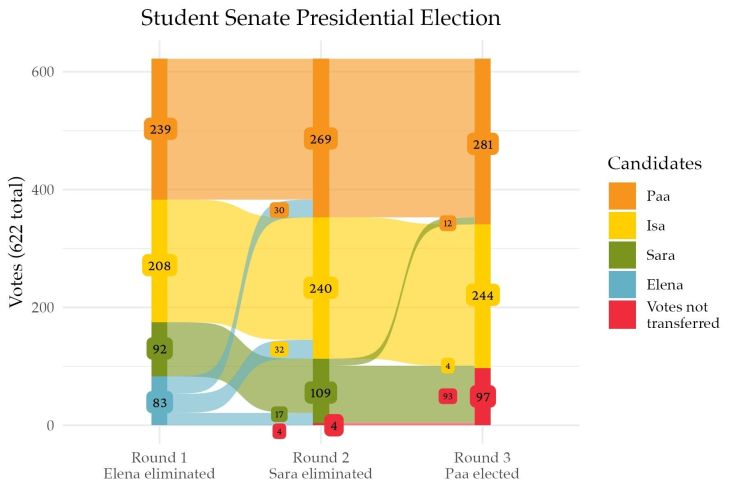
This graphic also didn’t make it into the print version, but it’s up online! Made using R with some additional labeling done manually.
Visualizing ranked choice voting data was a fun challenge, and while I ended up having to do some work outside of R to get it looking exactly how we wanted, figuring out how to reshape the data so geom_alluvial() would plot it correctly was a fun puzzle.
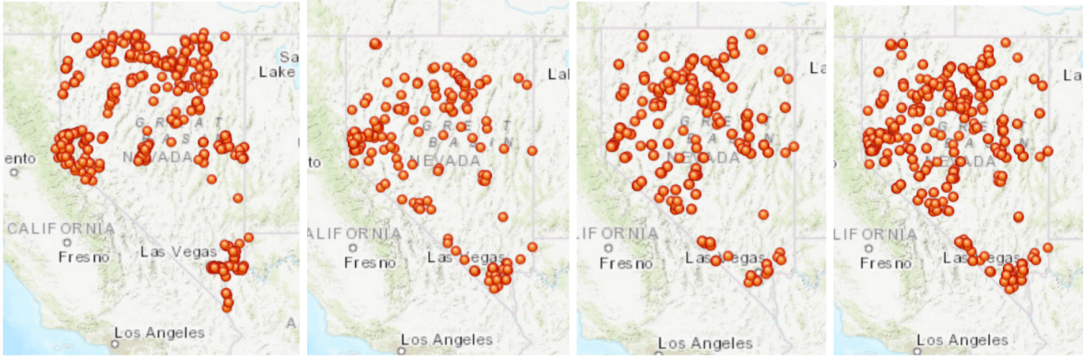
I finally got my term project for the GIS for Data Science class I took in Fall of 2022(!) up on GitHub. It was my first real experience with the “data science is 90% data cleaning, 10% fun stuff” thing and I certainly learned a lot!
I’m blessed with an Esri license through my school, so the analysis uses arcpy, the ArcGIS API for Python, and Spatially Enabled DataFrames. The final product was a writeup with some data visualizations and more extensive data communication through an ArcGIS (Jupyter) Notebook, both of which are now hosted publicly on GitHub along with the geodatabase with the data I used.
aka: Analysis and Classification of a Sample from the Ronald N. Hartman Meteorite Collection.
What follows is a write up of my term project for the Meteorites and Solar System Evolution class I took at Pomona College in Fall of 2023.
Introduction
Meteorites provide a window into the very earliest days of the solar system and document the turbulent life of rocky bodies in outer space. Classifying meteorites is an important part of the study of meteorites as it provides structure to the information one can gather from a meteorite, indicates possible information about the meteorite’s parent body, and communicates this information to others succinctly.
Much of the process I use in this project to collect data on and evaluate my meteorite was first introduced to me in Dede Chapline’s 2023 Pomona College senior thesis project titled “Petrographic and Geochemical Analysis of Selected Samples from the Ronald N. Hartman Meteorite Collection.” Her thesis does not seem to be publicly accessible, which is a shame, because it’s a great piece of work. For her thesis, she pulled a set of meteorites from Pomona’s collection and classified them using the technology available at the college. Here, I follow her procedure with just one meteorite, and I’m greatly indebted to her work with the collection.
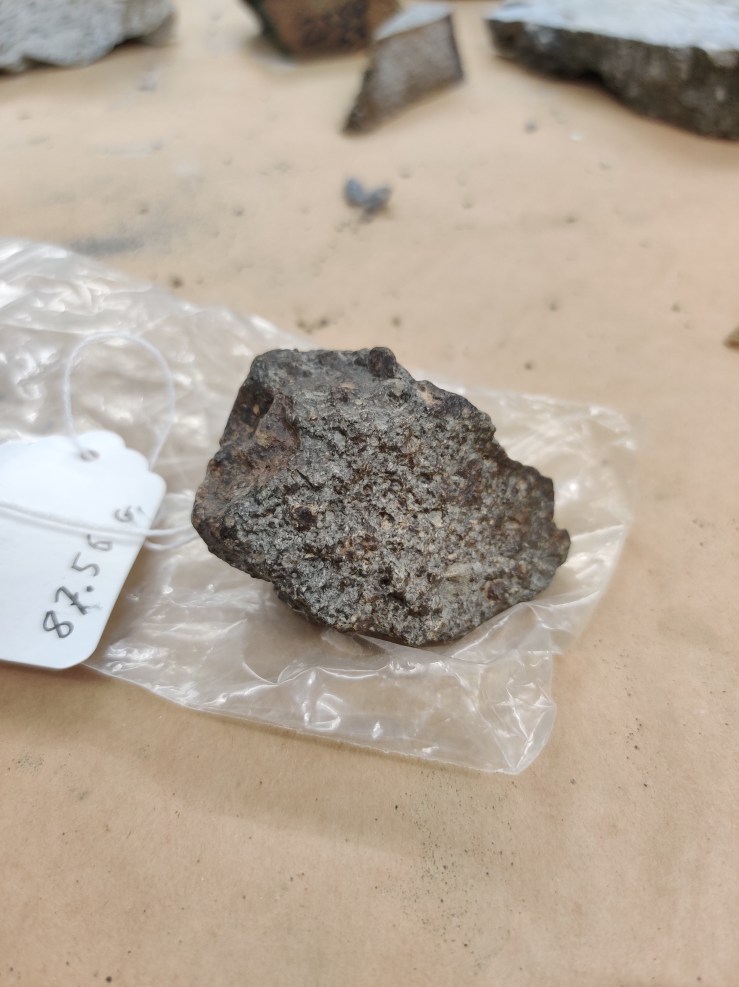
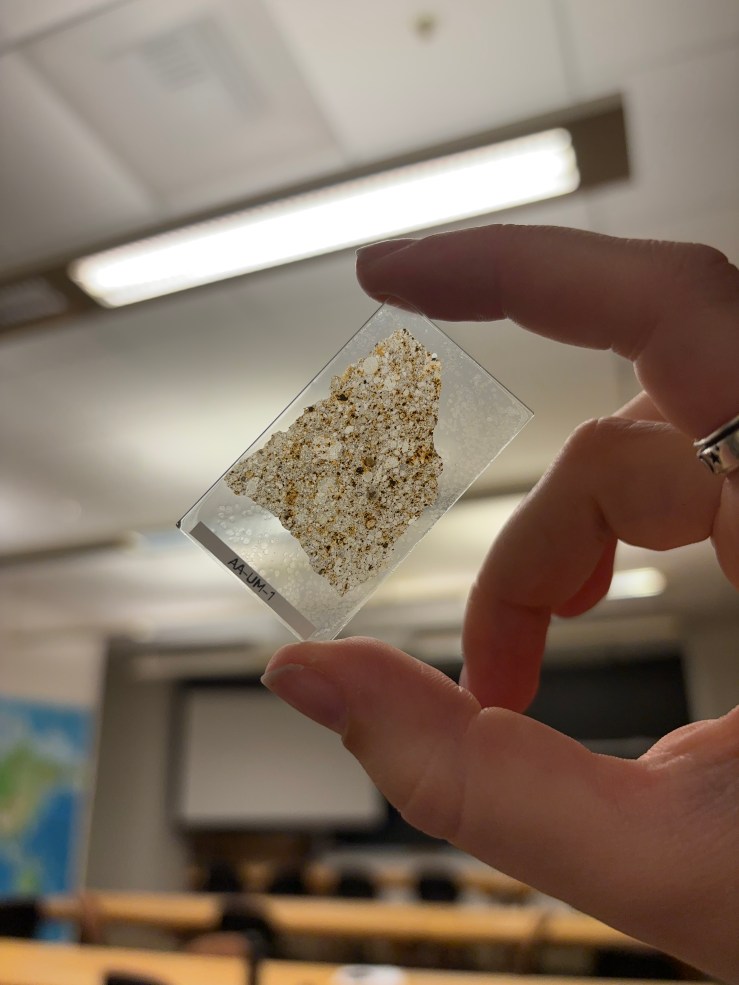
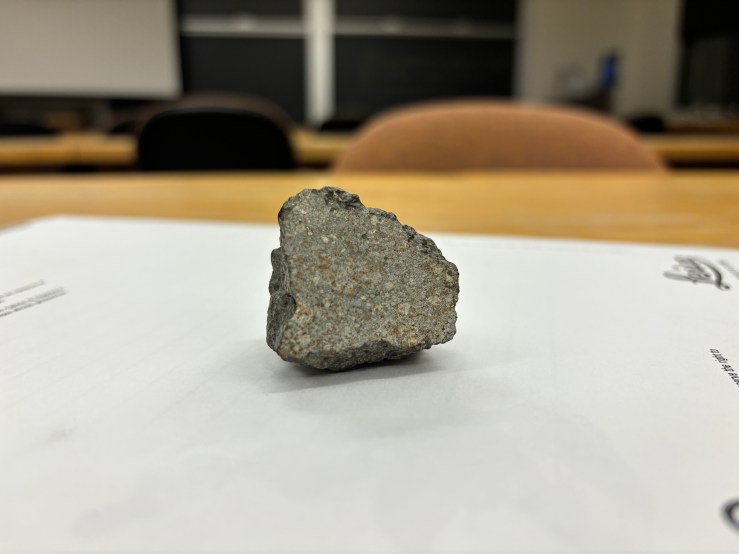
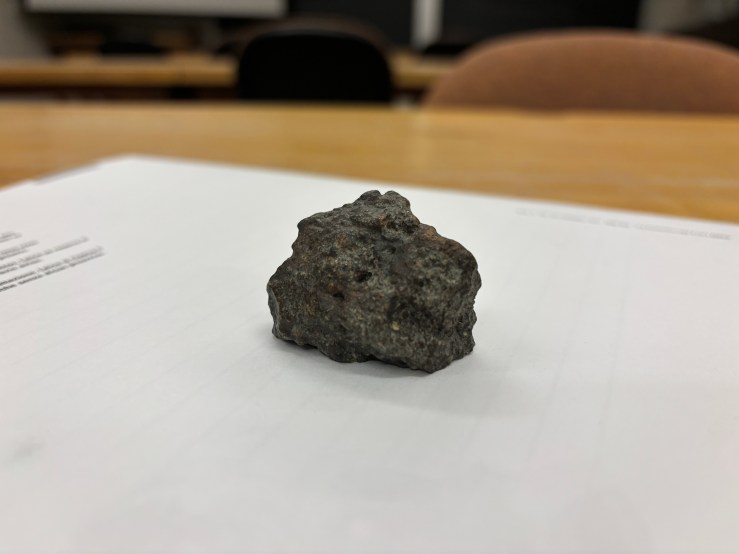
Pomona received a set of largely unclassified meteorites in 2011, according to research Dede did on the history of the collection. I chose one meteorite from this collection that had still not been classified, and labeled it AA-UM-1 (Ainslee Archibald Unknown Meteorite 1). I chose it specifically because it had not yet been cut open for hand sample analysis or thin section analysis. The hand sample before slicing and thin section preparation was 87.56 g and had no other information with it. It is somewhat angular with a little ablation and a light fusion crust (Fig. 1). The sample also has visible weathering from its time on the Earth’s surface, as it is a find rather than a fall. When cut open with the rock saw, the meteorite reveals chondrule formations and I estimate ~5% reflective metallic content (Figs. 2 & 3). It has oxidation halos and veins around speckles of metallic material. The texture is chondrule dominant, with relict chondrule material between more distinct chondrules. I thus conclude it is a chondrite, and focus my classification on determining which kind.
Figure 1: Fusion crust and ablationFigure 2: Chondrule formationsFigure 3: Reflective metal
The main classification framework for this project is based on the one laid out in Weisberg et al. 2006 (Fig. 4). In this framework, there are three classes of chondrites, Carbonaceous, Ordinary, and Enstatite (in addition to two groups that don’t belong to any class). These classes are further subdivided into clans and groups. The objective for this project is to classify AA-UM-1 into a class, clan, and group.
In classifying the meteorite, it is important to consider the overall mineral modes. Specifically, I gather data on the iron content and the ratio of olivine to pyroxene in the meteorite because I theorize the meteorite is an ordinary chondrite because of visual similarity and how common ordinary chondrites are when compared to other classes. Information on iron content and the ratio of olivine to pyroxene is important to delineate between the H, L, and LL clans of the ordinary class. Petrographic characteristics are also important for classification, so I specifically investigate the relative amounts of matrix, CAIs, and chondrules and the size and texture of chondrules.
Secondary objectives to the issue of classification are to determine the meteorite’s petrologic type, shock grade, and weathering grade. Petrologic type describes the degree of aqueous alteration and thermal metamorphism and can be determined by thin section examination. Shock grade and weathering grade are also determined through thin section examination.
Methods
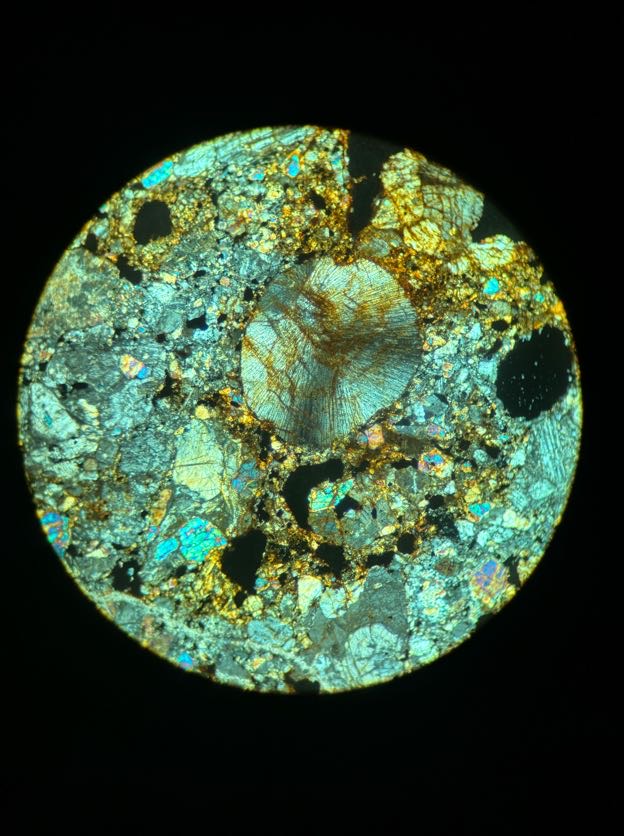
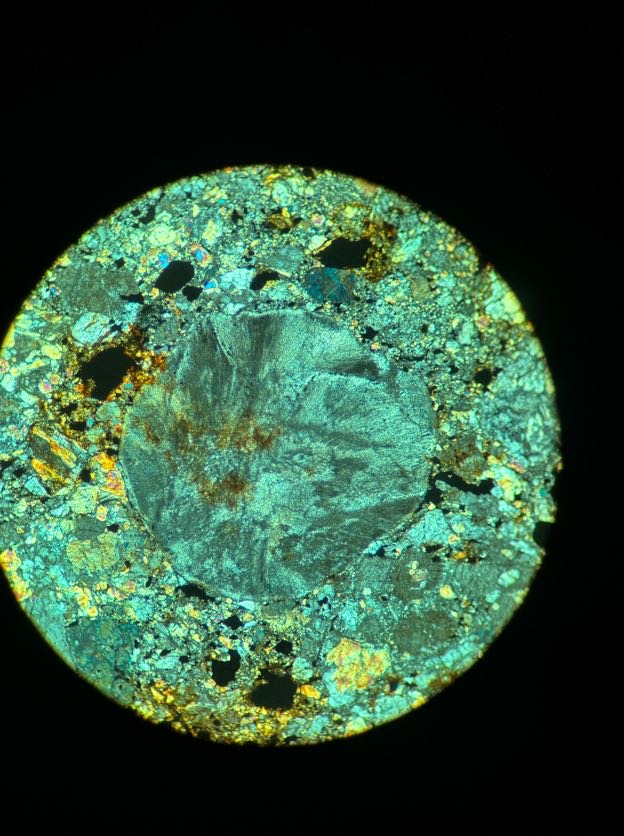
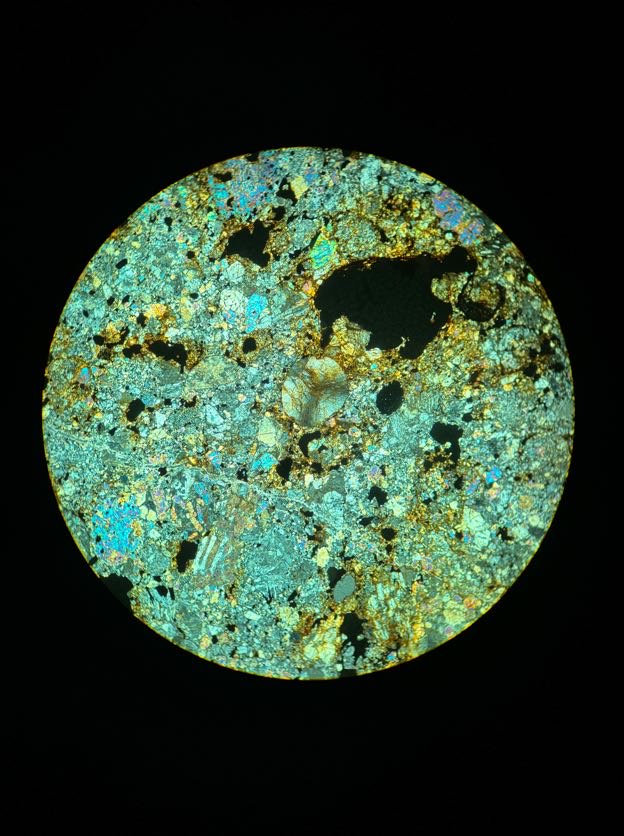
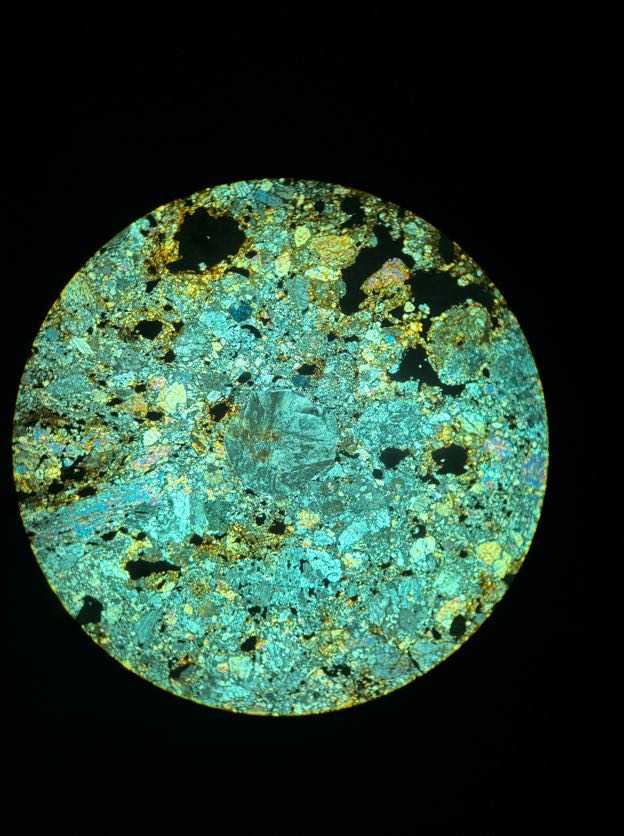
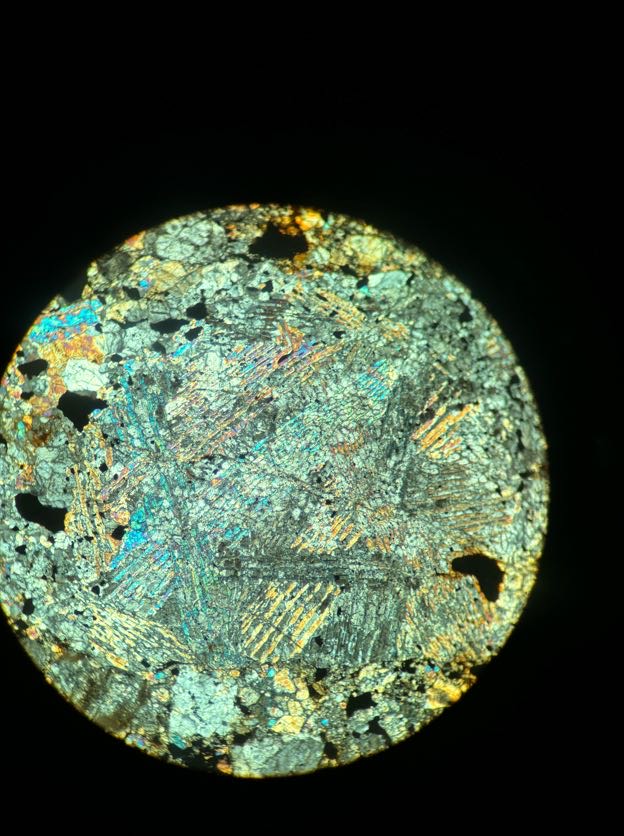
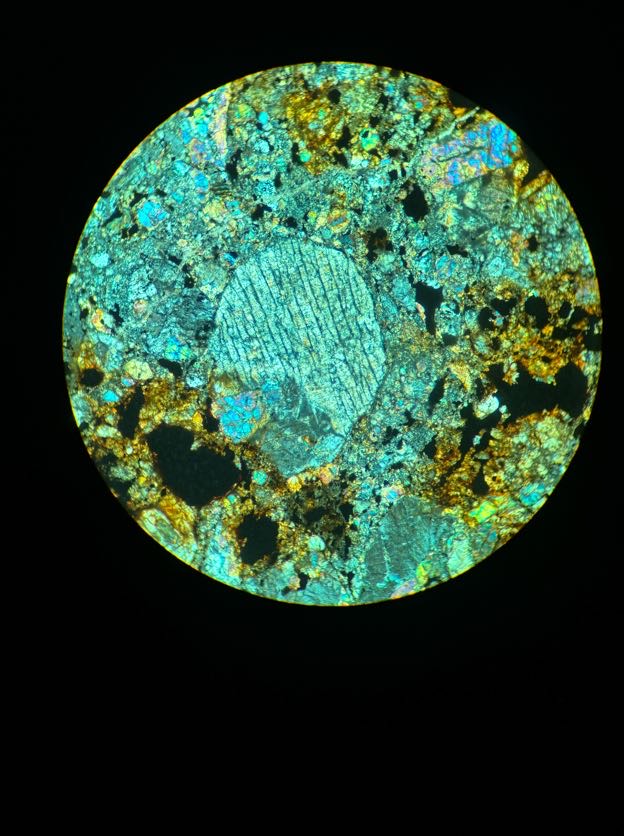
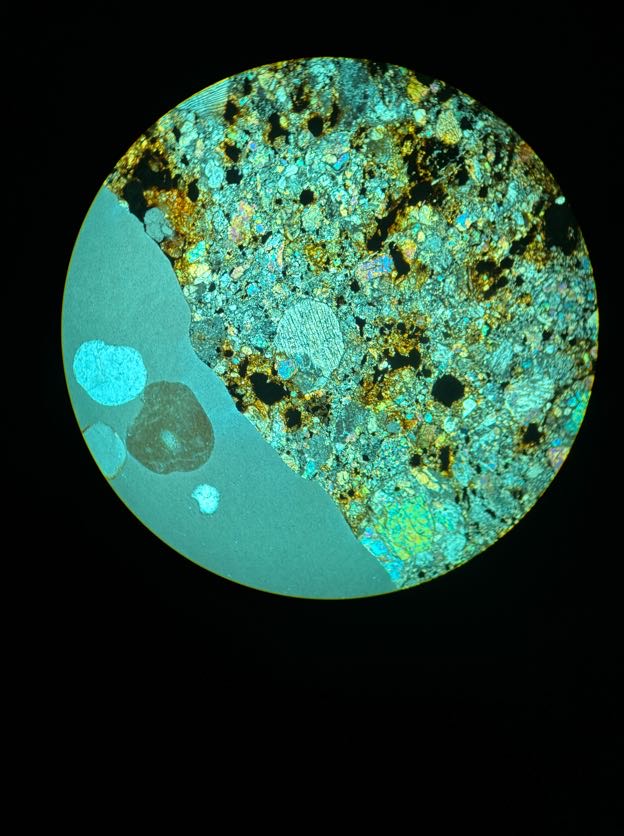
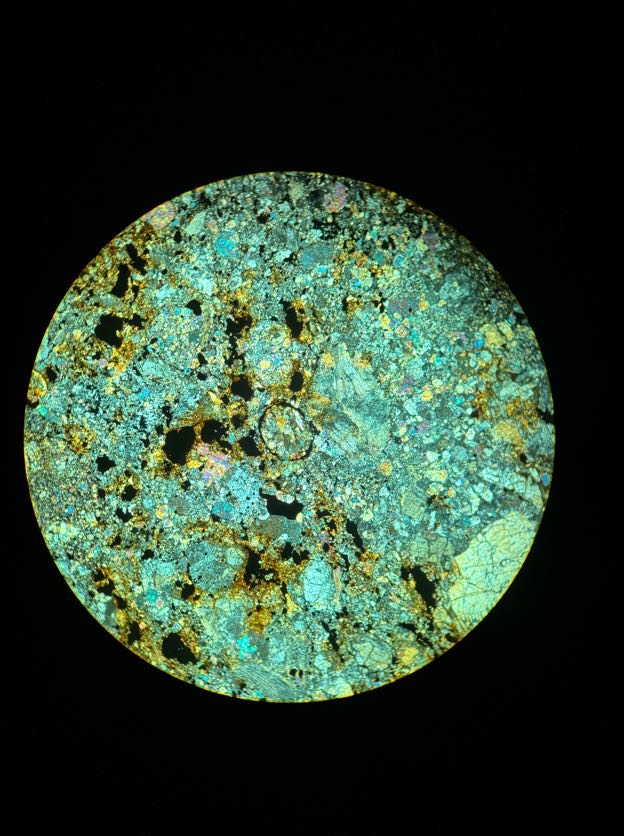
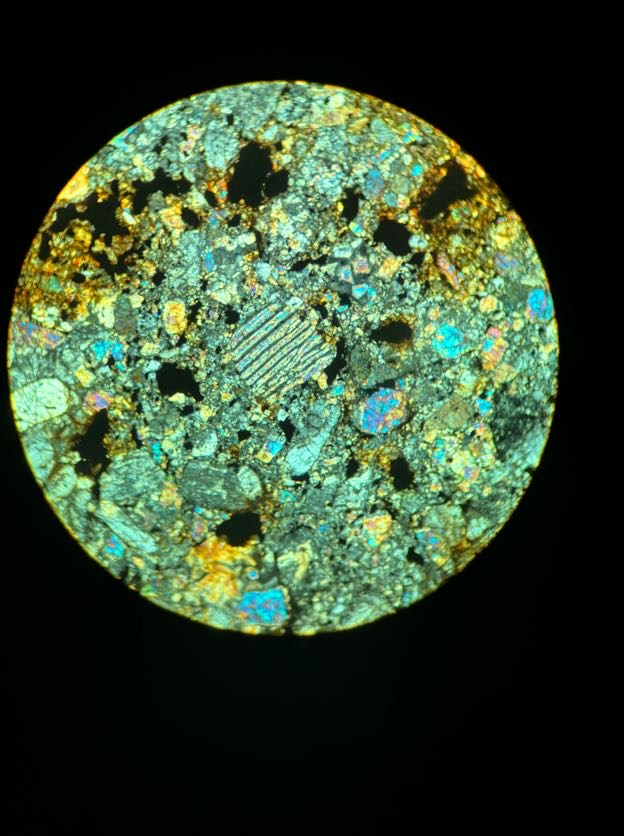
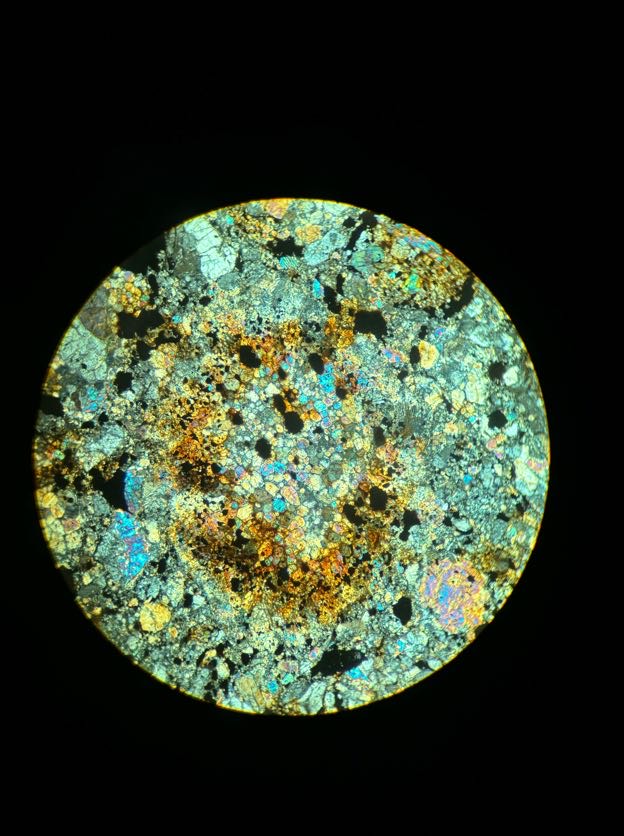
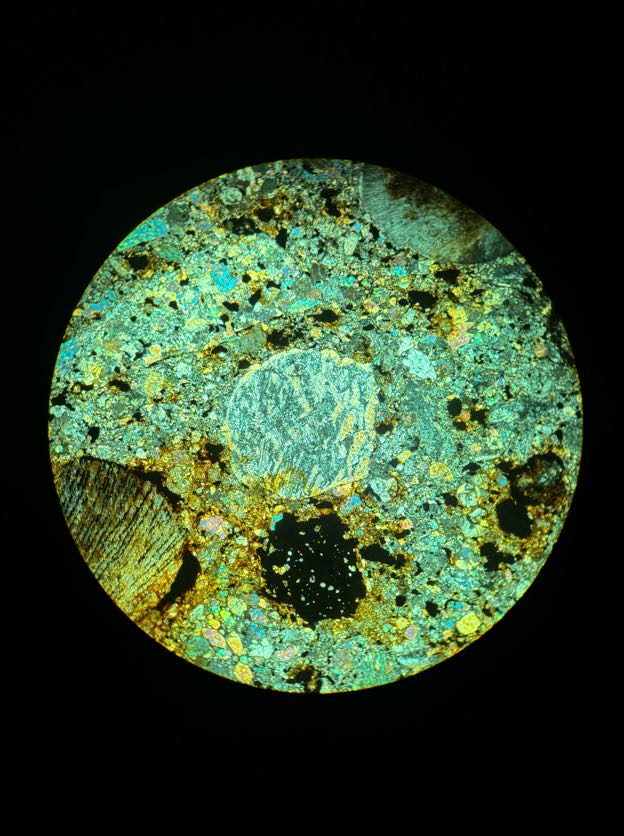
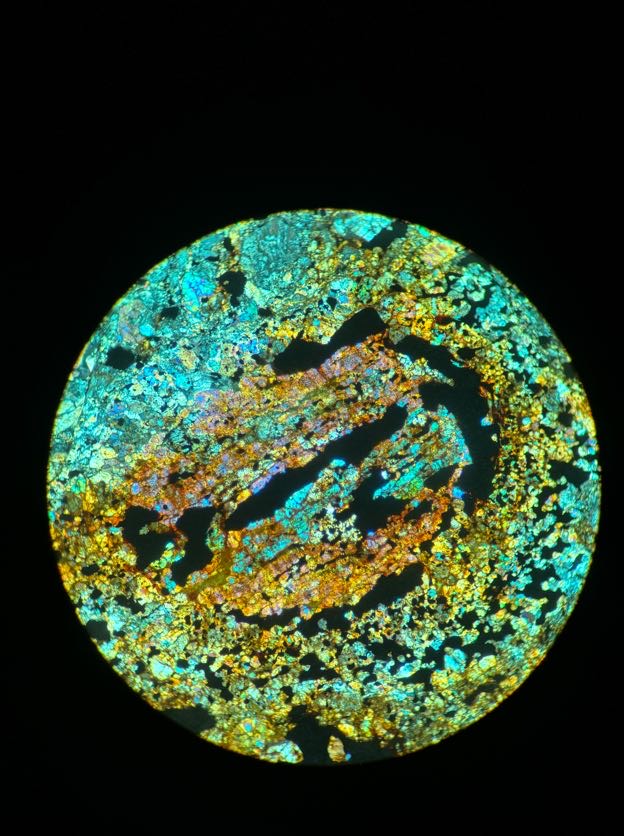
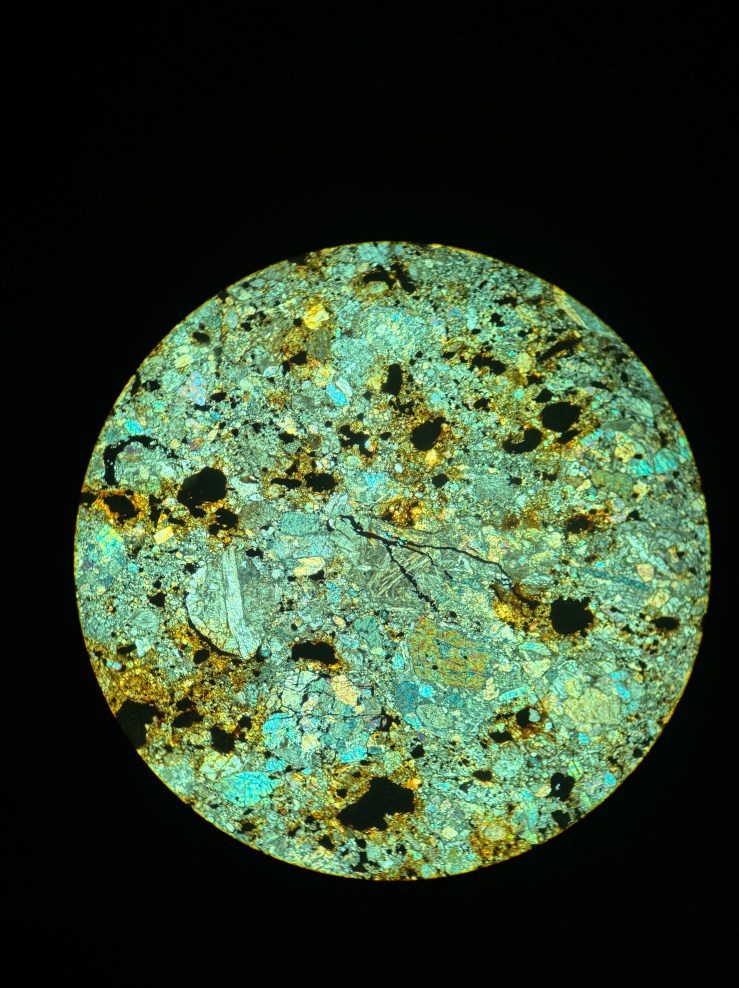
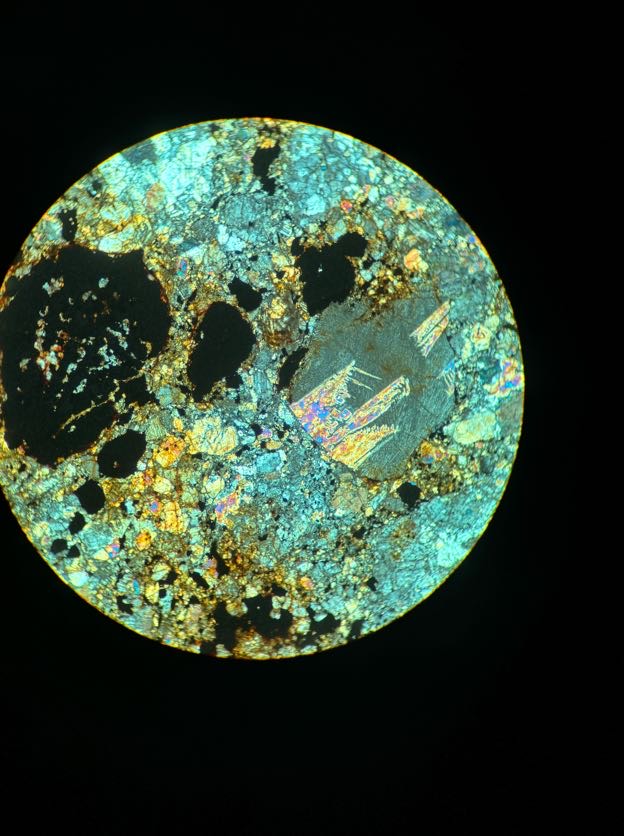
After choosing the meteorite and observing the hand sample, I cut a billet and send it off to be made into a thin section. I look at my thin section in both plain polarized light (PPL) and cross polarized light (XPL) on a Leica DM750 Microscope to determine many petrographic characteristics. I investigate the first-order mineralogy in the thin section to identify which common meteorite minerals are present and their abundances. I also note the size of the chondrules and the distinction of their textures. I approximate the metal abundance by viewing it under PPL. I search for CAIs and evidence of shock. I estimate the relative amount of matrix versus chondrule and note the amount of recrystallized matrix. I record this information via notetaking and document the evidence via mobile phone photography.
In addition to examining a thin section, I conduct Wavelength-Dispersive XRF Analysis. I powder 1.0017 grams of the sample using the agate dish in the RockLabs SRM C+RC shatterbox. Agate is used to avoid metal contamination. A fused bead is created to homogenize the sample for analysis. A high dilution of 4.0075 flux for a 4:1 flux to sample ratio is used. The spectrometer measures major elements and selected trace elements.
Data/Findings/Results
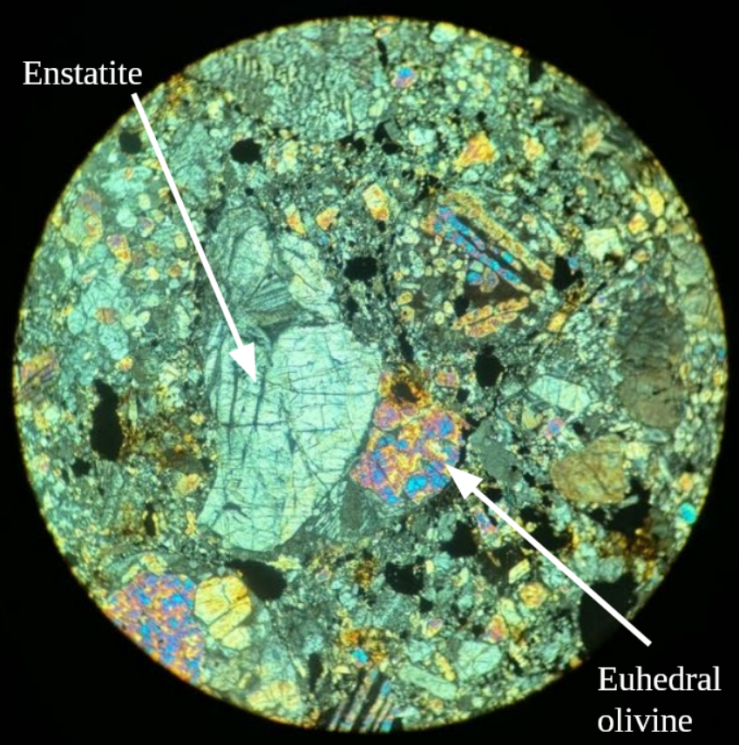
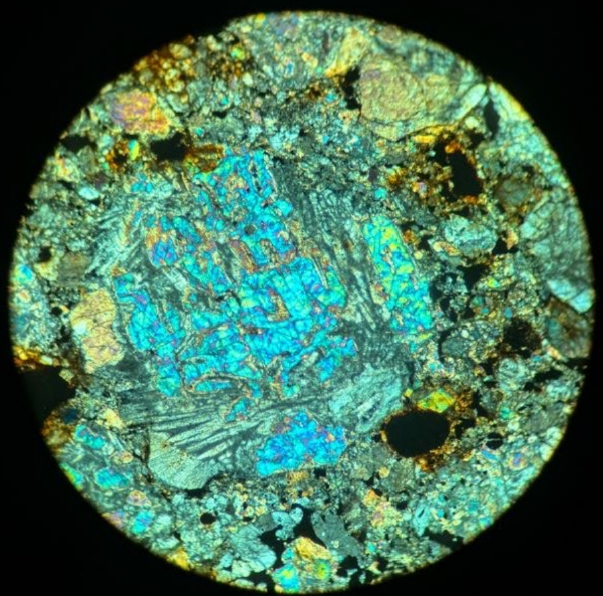
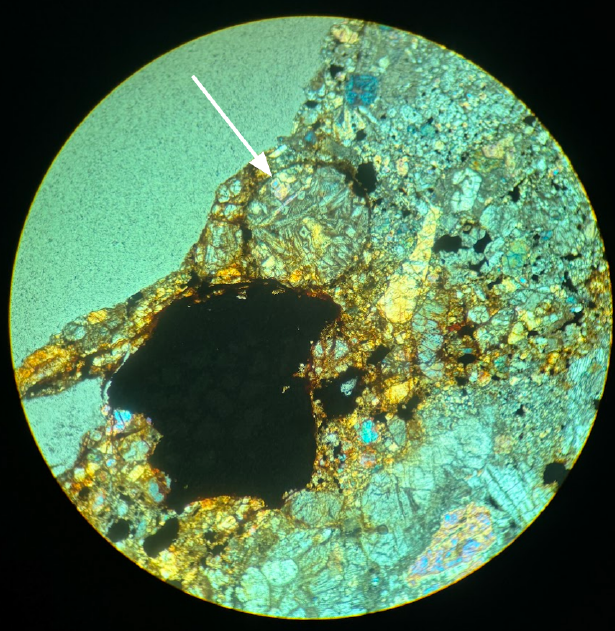
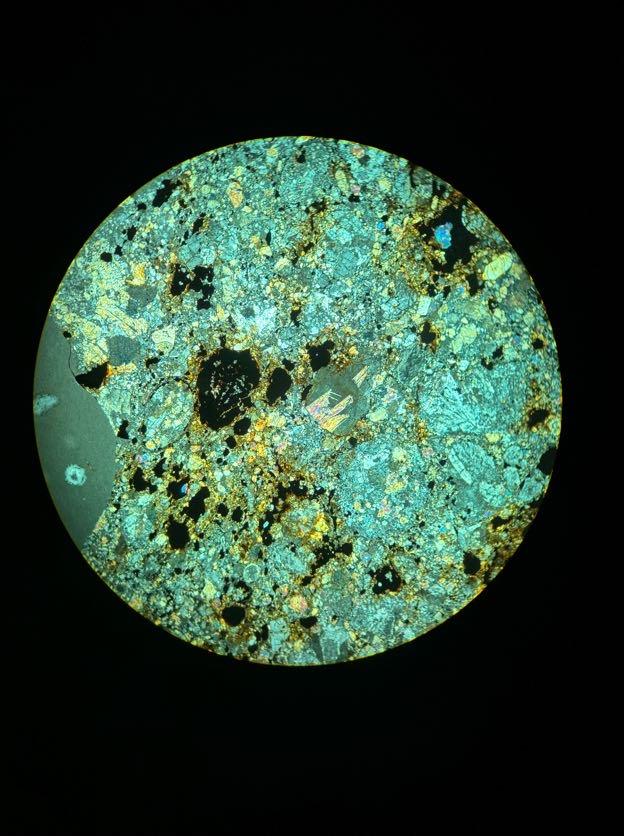
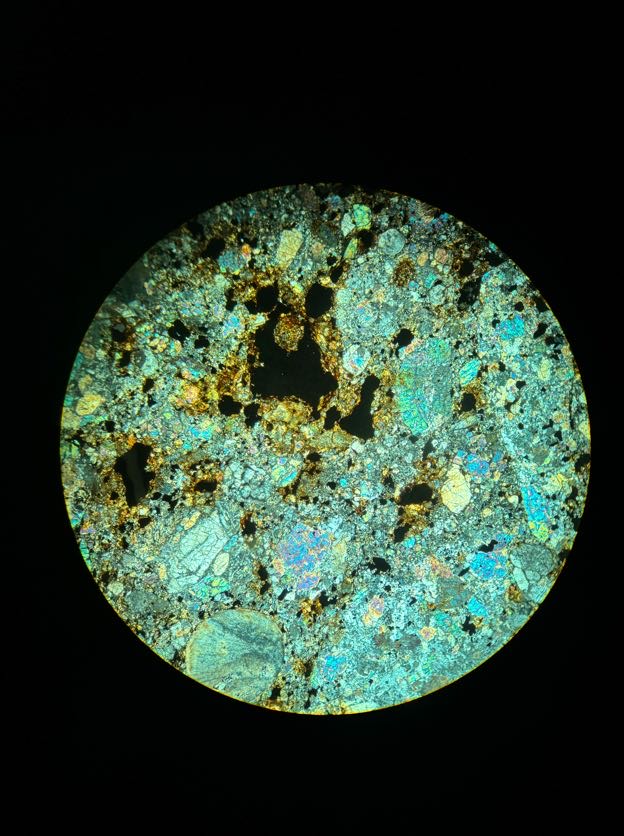
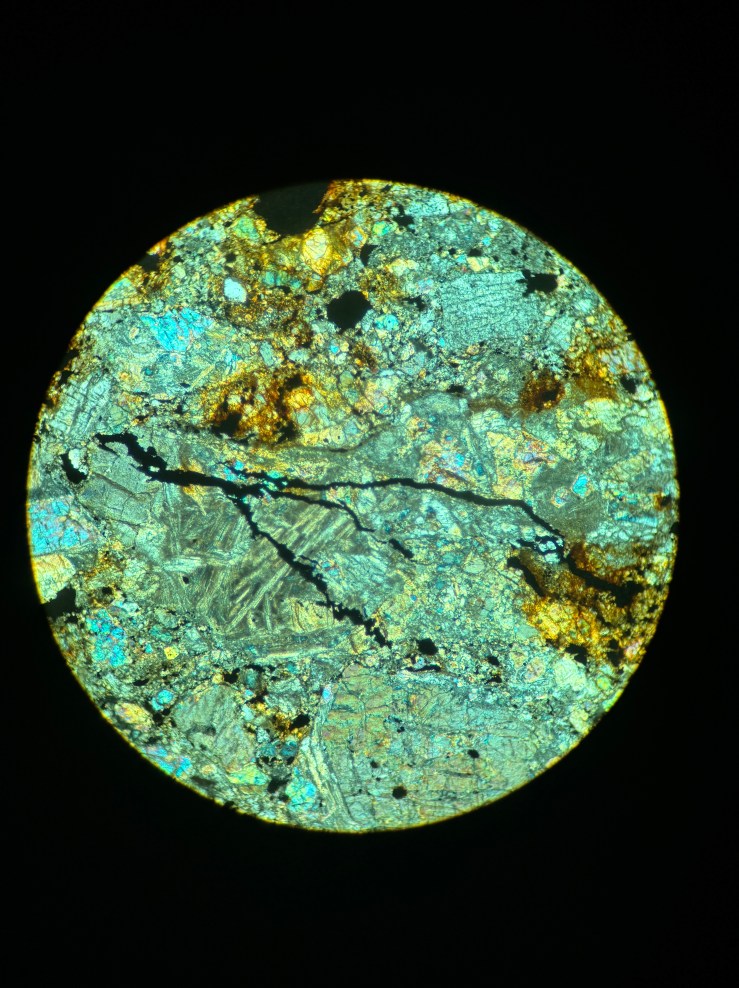
Petrologic type is determined by the condition of the chondrules and matrix minerals relative to their ideal crystal form. Most chondrule types are represented in the sample (Table 1). The composition is chondrule-dominant, with most of the material being poorly defined relict chondrules with some moderately defined chondrules rather than glass, metal, CAIs, or recrystallized grains. There is significant evidence of matrix recrystallization, however, as there is very little visible clear, glassy matrix. In between moderately defined chondrules are occasional euhedral olivine grains and some brecciated enstatite (Fig 5.).
Figure 5: Euhedral olivine grains and some brecciated enstatite within a recrystallized matrix.
The field of view is ~2.2 mm.
I am unable to find any clear examples of CAIs in the thin section. The approximate free metal abundance in reflected light in the thin section is 5%.
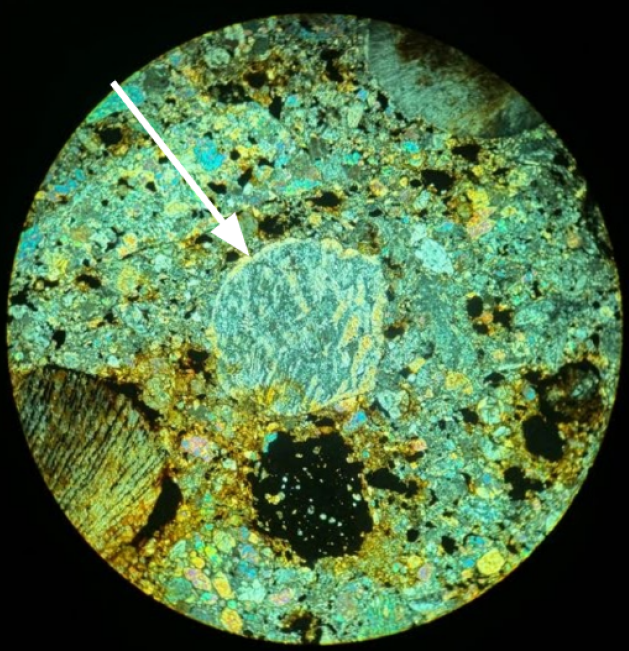
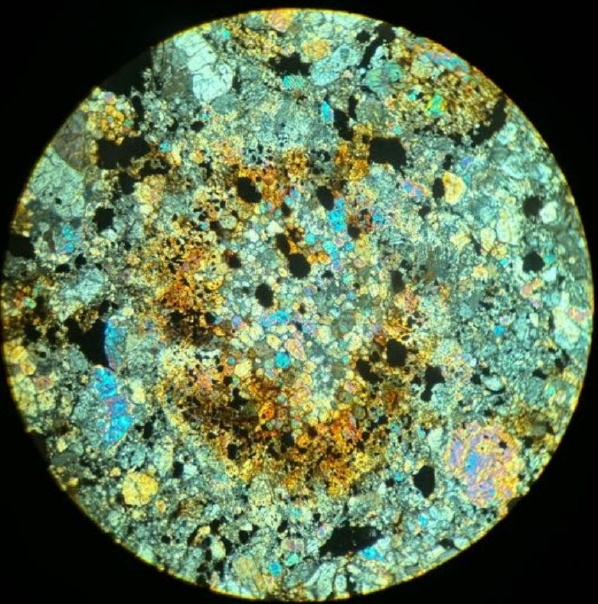
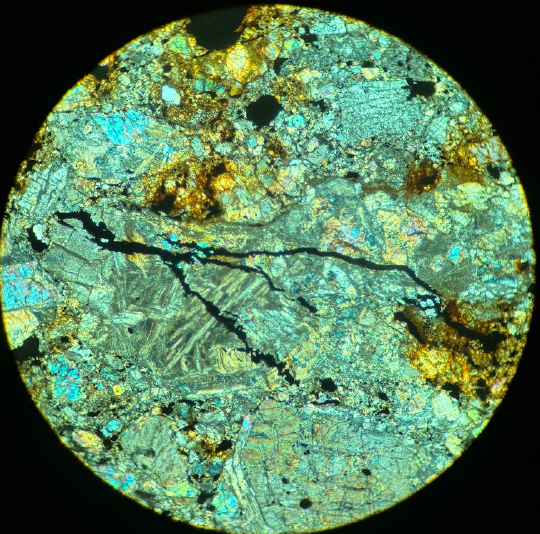
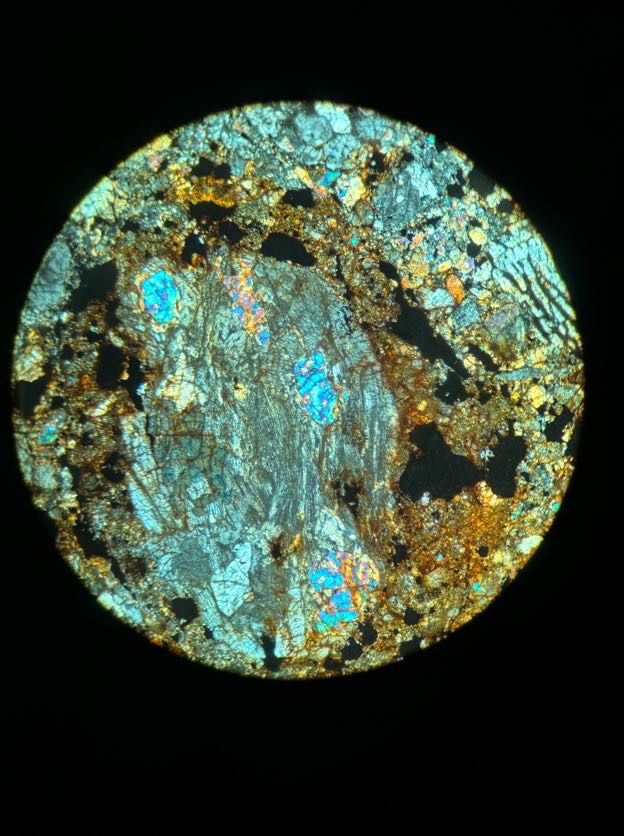
Determining the shock grade requires an assessment of shock effects in the thin section. The meteorite demonstrates non-uniform extinction and therefore can be described as metamorphosed. The crystal grains display undulose (but not mosaic) extinction throughout the sample in pyroxene and some olivine (Table 1). There are two shock veins present, one with glassy material and one with opaque crystalline material (Fig. 5, Fig. 6). Similarly, determining the weathering grade requires an assessment of oxidation and silicate replacement in the thin section from time on the Earth’s surface. The meteorite has significant metal oxidation and staining (Fig. 7).
Figure 5: Shock vein (glassy)
(~2.2mm)Figure 6: Shock vein (opaque along line) (~5.5mm)Figure 7: Metal and oxidation (~5.5mm)
The results of the whole-rock chemistry from the XRF spectrometer described in the Methods section are within the ranges expected for the meteorite, according to Dede’s thesis. The SiO2 weight percent is 36.94%, Al2O3 is 2.01%, Fe2O3 is 30.59%, MgO is 23.5%, and CaO is 2.14%. The total oxide weight percent is 98.282%. Plots of important elemental ratios as compared with known ordinary and carbonaceous chondrites both from the literature and from the Pomona collection can be found in Figures 8 and 9.
Discussion: Implications, recommendations, and conclusions of the work
First, I’ll discuss the implications of the petrographic analysis. The chondrule-dominant texture present in the thin section (>70% chondrule material) and lack of evidence of abundant carbon in the XRF rules out carbonaceous chondrite class and the Rumuruti-like and Kakangari-like chondrite groups, and the presence of barred olivine chondrules rules out the enstatite class, leaving only the ordinary class.
There are three groups of ordinary chondrites, H (high total iron), L (low total iron), and LL (very low total iron). They can be differentiated on the basis of their iron content, as the names imply, but also on mineralogy. LL chondrites contain more olivine and less pyroxene, H chondrites contain less olivine and more pyroxene, and L chondrites fall in the middle. AA-UM-1 demonstrates intermediate amounts of both pyroxene and olivine chondrites (in easily distinguishable chondrites, n=9 olivine, n=8 pyroxene, n=7 mixed or inconclusive).
The meteorite demonstrates some readily distinguishable chondrules, a recrystallized matrix with secondary minerals like enstatite, and metallic minerals. It can therefore be classified as petrologic type 4. This implies a moderate degree of thermal metamorphism.
The meteorite exhibits non-uniform, undulose extinction and two shock veins, one of which is opaque. This suggests a classification of S3 for the petrologic type. Meteorites of this shock grade are weakly shocked. Also, the meteorite demonstrates a heavy degree of metal oxidation and staining, and can be assigned a weathering grade of W3.
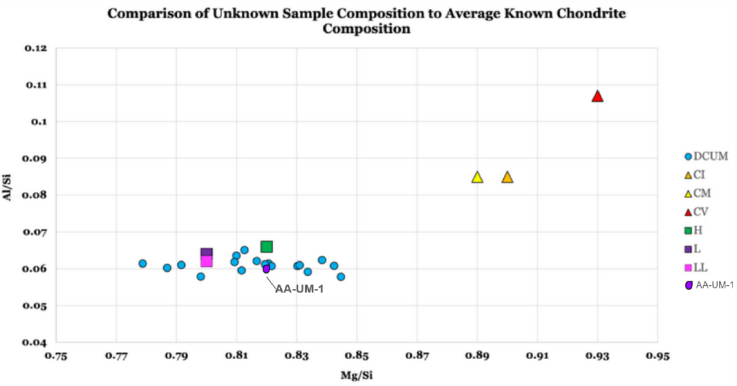
I can draw further conclusions from the bulk-rock chemistry, and it is especially helpful to compare AA-UM-1 to known compositions of chondrites. I plot the ratios of Mg/Si and Al/Si with ordinary and carbonaceous samples from Schoenbeck et al. (2006) and Dede’s thesis (Fig. 8) and from a compilation study of meteorite analyses by Jarosewich (1990) and Dede’s thesis (Fig. 10). Both plots show that AA-UM-1 falls cleanly within the range of ordinary chondrites, providing more support to ruling out the other classes. It is closest to the average chondrite composition of H group meteorites, but is in the middle of the range of Dede’s meteorites.
Figure 8: AA-UM-1 is the purple teardrop. Samples from Dede are blue circles. All other data (green triangles for carbonaceous chondrites, pink squares for ordinary chondrites) is from Schoenbeck et al. (2006). Adapted from a graph in Dede’s thesis.
Figure 9: Same plot as above, but with elemental ratios for different meteorite groups from Jarosewich (1990). Adapted from a graph in Dede’s thesis.
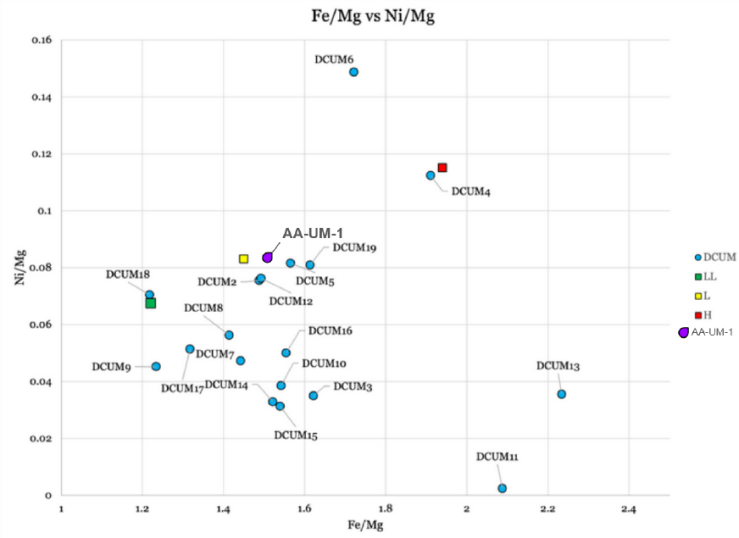
I also plot the Fe/Mg and Ni/Mg ratios to show the metal content in the sample. More iron and nickel will plot higher on both axes, which allows for differentiation between the chondrite groups. On this plot (Fig. 9), AA-UM-1 is closest to the L group average.
Figure 10: Plot of the Fe and Ni to Mg ratios for AA-UM, the samples from Chapline (2023), and additional data from Hutchison (1997). Adapted from a graph in Dede’s thesis.
Lastly, I plot AA-UM-1 by weight percent iron and metal abundance in reflected light in (Fig. 11). This again suggests it falls within the L group range.
Figure 11: Weight percent iron and abundance of free metal in reflected light for AA-UM-1 and Dede’s samples. Specifications for the groups H, L, and LL are from Saikia (2020) with extrapolation from Dede. Adapted from a graph in Dede’s thesis.
The majority of the evidence – the intermediate pyroxene and olivine composition, the total metal content (Fig. 9), and the weight percent iron especially when compared with the metal abundance in reflected light (Fig. 11) – all points to AA-UM-1 belonging to the L group of ordinary chondrites. The only data point against that conclusion is the Mg/Si and Al/Si plot with average known chondrite compositions from Jarosewich (1990) (Fig. 10), but when viewed with the data from Dede’s thesis that was developed with the exact same procedure on the same equipment, AA-UM-1 is revealed to fall squarely in the middle of the collection’s range.
Conclusions
In full, I classify AA-UM-1 as a low total iron ordinary chondrite with petrologic type 4, shock grade 3, and weathering grade 3 (L4 [S3, W3]). Classifying AA-UM-1 as an ordinary chondrite of the L group does not allow for a specific parent body to be determined. However, a small main-belt asteroid called 3628 Boznemcová has a similar spectrum to L chondrites and may be a fragment of the original parent body. The petrologic type of 4 suggests it may have formed at an intermediate point in the undifferentiated parent body. Having been classified, AA-UM-1 can be added to the growing library of formerly unknown meteorites in the Pomona collection.
For posterity, here are the full size, unedited, and unlabeled photos from this project. If you’d like to use them for something, they are openly licensed via CC BY-NC-SA 4.0.
Editor’s note: This post, copied wholesale from my (defunct?) Medium blog is more to serve as a placeholder than as a true First Post. Originally drafted and published in Summer 2022.
aka How to survive your first year at the 5Cs by someone who barely did
Disclaimer: I am a rising sophomore at Pitzer College. Many of these tips are relevant to college freshmen regardless of institution, but some of them aren’t. Also, I’ve only been in college for a year, so my advice may be rather bad. I take no responsibility for any harm that may come to you after following the tips laid out here.
Statue garden next to the freshmen dorms
Socializing, making friends, and how to avoid being lonely
I spent most of the first semester overwhelmed, depressed, and generally not interesting to be around.
My biggest regret from my first year, perhaps because of my bias toward prioritizing career and academics, is actually social in nature. I spent most of the first semester overwhelmed, depressed, and generally not interesting to be around. There are a variety of reasons for this, and I am not angry at myself for my mental state at the time. But I do wish I’d tried harder to be social when making friends was easy, during orientation and the first couple weeks of school. There are opportunities to make friends later on and lots of people don’t stick with their initial groups! But my lack of effort in socializing early made the first semester far lonelier than it had to be. If it’s at all possible, try to move past whatever is keeping you isolated so you don’t get left behind.
Other tips:
Go to everything. Talk to everyone. Walk up to random people on the mounds and start conversations. Ask that person you’ve spoken to once if they want to get lunch. Orientation is really the only time where this won’t be kind of socially awkward, so take advantage. Pitzer’s a pretty small school so if you’re good at this you’ll end up kind of knowing everybody by the end. If you’re not that outgoing, that’s okay, but try to make yourself available for other people approaching you! My main mistake was purposefully going off by myself because I was stressed, and I ended up missing a lot of chances to mingle.
Join more clubs than you think you’ll have time for and then drop a̶l̶l̶ ̶o̶f̶ ̶t̶h̶e̶m̶ ̶ the boring ones. The clubs live on Instagram (and Engage!) but you can also meet them at in person club fairs.
I’m not a party person, so take my perspective with a grain of salt! As far as I can tell, Pitzer students definitely go to parties, but we don’t generally host them. Instead, we sit in circles on the ground smoking weed and host small dorm room kickbacks. The freshman dorms are strict about alcohol, so Mead (the upperclassmen/senior dorms) gets the most action. Claremont McKenna is right next door if you’re craving the frat party experience. The other colleges also host big loud college parties if that’s more your vibe.
Most people move Student Talk (our unmoderated student email list) to a separate folder or unsubscribe entirely. Personally, I think that’s the coward’s way out, but I like having a million notifications.
Keep in mind that a big part of the school will see your Student Talk posts, and proofread them accordingly. It tends to reproduce some of the negative aspects of social media. Be cautious when expressing potentially controversial opinions.
The chickens are your new best friends.
Courses, registration, and whether college is actually hard
I took a gap year after the last semester of high school during which my school district basically gave up during COVID. I expected the re-entry into education to be rough after this extended break. It was, but I also think my professors were aware that their classes had a lot of freshmen and scaled difficulty over the semester accordingly. So be stressed, but not that stressed. There’s a lot of support available and you will most likely be fine. Pitzer is generally easy on grading, anecdotally the easiest of the 5Cs. Unless your professor’s ratemyprofessor is a crime scene, your classes will probably be manageable.
Hiding from my homework in the library
Other tips:
If you want to force yourself not to leave an essay until the last minute, schedule a Writing Center appointment for a bit before the deadline. Now you have peer pressure to actually write a draft in advance! They also generally give good feedback and are especially helpful if you don’t have much college prep essay writing experience.
Registration is hell. You’ll feel like you got screwed regardless but it’ll shake out in the wash. Send PERM(ission to enroll request)s early and, if you’re not a coward like me, follow up emails to the professors. In theory you’ll get an email if one’s accepted, but it’s worth checking back regularly.
Here’s a template PERM: Hello! I’m [first name], a first year interested in studying/majoring in [subject]. [interesting perspective you’d bring to the class, why you’re interested in this subject specifically, what the class would do for you or something else to make the request standout. Keep in mind everyone submitting a PERM is presumably interested in the subject] so I’d like to take this class! Thank you.
The registration portal is incredibly bad. I recommend using hyperschedule (simpler scheduler), 5scheduler (more complex scheduler with more features) and/or ClaremontCourses to supplement it.
Keep in mind walk times between classes. I did not enjoy having a fifteen minute buffer between two on campus classes in the second semester because it felt like I always had to rush.
I’m currently speed-running the calculus sequence over the summer, and let me tell you, it’s not ideal. If you think there’s any smidgen of a chance that you’ll choose a major path that requires it, figure out your plan early. Start it first semester if you can. I really recommend taking the placement test(s) even if you don’t think you’ll need it, because you’ll only forget more as time goes on.
Obsessing over registration and grad/major requirements was not healthy but at least I’m done with most of my Pitzer graduation requirements. I’m under no pressure even though I’m starting my major at the beginning of sophomore year. You can find the graduation requirements on the major declaration form and the major requirements (along with lots of other helpful info) in the college’s catalog. I recommend making your own version of these sheets to reference and fill out. I use Notion but a Google Sheet would work as well.
As everyone says, you should go to office hours. Now, I didn’t go to office hours unless I was at my breaking point. It usually worked out for me, but I would have been a happier student if I went more regularly. Next year I’m going to try to build relationships with the professors outside my crisis times. Part of liking your professors is taking the time to get to know them. It’s a lot easier to enjoy yourself if you like your professors.
Go study at the big library; it’s what it’s there for. Talk to a librarian about something, check out their events, wander the halls, even check out a book. It’s not actually that long of a walk from Pitzer; you’re just lazy.
Don’t take an 8 am class. Just don’t, man. It isn’t worth it.
Congrats, it’s now time to choose your major, career, and life path…
Okay, not really. You don’t have to declare your major until registration begins for junior year (so about 2/3rds of the way through sophomore spring). But if you’re eligible for work-study, you should get on that as soon as possible as there’s a decent amount of competition. If you want the best choices, you should try to beat the more disorganized people to the applications. I didn’t have an issue but I had existing job experience, started early, and applied to a bunch of jobs. I know some people got screwed by the system, so keep an eye on it. There will be info coming out about it someday, but the main thing is to look for new job postings on Handshake.
Boring work-study jobs are good because you can do homework. That being said, I’m keeping the busier of my two jobs because I have a closer relationship with my manager. Keep in mind whether you like the vibes of the person you interview with if you have job options.
The Kravis Center from the big library’s patio
Other tips:
If you want to do computer science, buddy, you are at the wrong school. Do yourself a favor and a) figure that out quickly and b) transfer. Don’t be like me and end up with a data science major. Okay, I’m joking; I do want my major! The data science program at CMC is good and Pitzer is a decent choice if you want to do data for a social science. [Edit: I’ve heard from another student that about 80% of the Pitzer freshmen who wanted to get into the Harvey Mudd classes required to major off campus in CS were able to. I haven’t spoken directly to the source on this, but I have to assume it’s accurate. In that case, my advice is to have a backup plan to transfer ready to put into motion if you don’t get into the necessary classes.]
Off campus majors are more unstable and less flexible, especially if they’re impacted (overfull). Planning on coming to Pitzer but majoring somewhere else is a gamble. You can check the majors and minors Pitzer offers here. The general rule is if Pitzer doesn’t offer it but another college does, Pitzer will allow you to join the off campus program. Whether the other college will take you is… less of a guarantee.
If you’re planning on studying abroad, it’s worth it to talk to an advisor early, especially if you already have your major plan worked out.
I worked in the Career Services office last year and can vouch for their passion for helping us with job stuff. If you need interview prep, connections, help with Handshake or a similar tool, resume reviews, or even just someone to discuss some broad interests with, they’re a helpful resource.
How to live with strangers and also home decorating tips
I’d never shared a room with someone for longer than a month and a half before college and I worried about how it’d turn out. Luckily for me, my choice to leave my roommate selection up to Pitzer was a good one. I got along fine with my roommate, settling somewhere around amicable acquaintances with no major issues. I didn’t get to know my suitemates much, but aside from some disagreements over cleaning (my bad for being irresponsible, honestly) we got along as well.
I’m lucky, though. Switching roommates is more common than you’d might expect and lots of people have roommate horror stories. Regardless, whether you find someone or let the algorithm choose for you, once it’s done there’s nothing much to do other than hit each other up on Instagram and hope no one’s weird.
Loft your bed!
Other tips:
Plan on coordinating buying a mini-fridge and microwave with your roommate. The budget option is ReRoom (students selling cheap stuff from previous students) during move-in. You may also want to discuss bathroom accoutrements with your suite, whether that’s rugs for the shower or storage for the bathroom. For people who menstruate, some kind of shelving and a small trash can in the toilet room will keep things organized.
Loft your bed. The only downside is it makes making your bed a nightmare, and also you might fall out of it. Otherwise it’s all wins. So much extra space. You’ll find out whether your bed loft application was accepted soon enough to plan around it, but you may arrive on campus and find it has not actually been lofted yet. If that happens, you should bug facilities about it.
Set up a cleaning schedule with your suite and then stick to it as best as possible because arguing over it sucks. Do your best not to be like me and leave dirty dishes in the bathroom for days. Have compassion for yourself when you do.
If you live on the ground floor and have interest in a hammock, you should get one and claim the space before your neighbors do. Also, having plants or a laundry hanger or whatever in front of your dorm increases overall vibes.
Don’t worry too much about forgetting things if you can afford to buy duplicates once you get to campus. There’s a Target nearby with weekly shuttles from campus, and I think they make it available as early as orientation if you forgot something important. I bought a trash can.
If you have the storage/luggage space, I’d recommend bringing a lot of clothes so you don’t have to do weekly laundry. The laundry rooms can be pretty crowded at peak times.
Miscellaneous campus life stuff
Biking is a big thing on campus! I don’t do it because I haven’t needed to for off campus classes yet, but lots of people bike. There’s a program to provide bikes and bike repair for students, but it took a while (a couple months, if I remember correctly) to get started. Hopefully that was an outlier due to COVID. You might want to bring your bike from home if you’re able. If you don’t know how to bike, look into learning over the summer.
Freshmen do not get parking permits, with very few exceptions (frequent off-campus medical appointments and approved internships, I think). Sophomores do not get parking permits unless they get placed in off-campus housing (okay, technically they call Claremont Collegiate Apartments “on-campus” but it’s not), with very few exceptions. Juniors might get parking permits if there aren’t too many sophomores with them. Seniors get parking permits.
They’ll tell you there’s an on-campus car rental system called Zipcar, but I’m pretty sure it doesn’t exist. If you want to go farther than the village, you will need a rideshare, a friend with a car, or a willingness to brave LA’s public transit system.
The Green Bike Program (and a big pile of fertilizer for the garden)
Other tips:
You need comfy walking shoes, especially if you have off-campus classes (you probably won’t as a first year) or if you plan on frequenting the village. There is so much walking in college. See also: figuring out how to pack your bag lightly, finding something that doesn’t hurt your back, and selecting lighter supplies.
McConnell is good, actually — don’t let anyone tell you otherwise — but also if/when they open cross campus dining, take advantage. It rules. The Pit Stop is good (❤ to the baristas) and the Shakedown is… fine (I have heard it described as “stoner food”).
Probably start with the lowest meal plan and then bump it up if you seem to run out. Adjusting it down is more difficult.
The Outback is cool. You should go hang out there.
It’s hot and humid in Claremont, so be prepared to be a sweaty mess for a while. Pack a lot of shorts, short sleeves, and a couple light jackets for the nighttime and you’ll be fine until Thanksgiving Break.
Go to the pool when it’s warm because it won’t be warm forever!
If you need to pick up prescriptions, you’ll probably do so at Hendricks Pharmacy in the village (about a 30-minute walk from campus).
You’ll get medical care from Student Health Services. If you have a medical history, adding it to the health portal once you get access will make your life easier later on. You can also schedule appointments over the summer for the very start of school if you have something you want to get help on as soon as you get to campus. Keep in mind that SHS is a clinic, not a hospital, so unless it’s a service they mention on the webpage you may end up needing to go off campus.
If you already have healthcare, don’t forget to opt out of the student plan (SHIP). Don’t worry too much about forgetting, though; it’s a ton of money and the school will email you about it a lot. I think the form’s due in September.
Air quality kind of sucks here (smog and forest fire smoke), so if you have allergies or existing respiratory issues you may want to invest in an air purifier and plan on keeping an eye on AQI.
Thanks for reading all that! I hope it was helpful. Overall, I think these tips matter but keep in mind, it’s your first year. I didn’t know about most of them until significantly into the first semester, and I’ve turned out fine. You do not have to take registration or major planning very seriously, especially if you’re not planning on doing a demanding STEM degree, studying abroad, or going to a competitive grad school. Pitzer’s graduation requirements are pretty light. There’s a reason the vast majority of people who graduate do so in four years.
As difficult as it is for me to admit, academics are only part of the college experience. Most of the work I did to figure out myself and who I want to become was not done in the classroom. I hope you’ll remember to close the laptop and go live some, too.
Acknowledgements:
the 5C Discord saw it first
thanks to Hannah for asking the question that led to the first draft of this
thanks to Max for perspective on the data science major and laundry
thanks to Regan for better information on the party scene



























 Ainslee Archibald